Executive Summary
- Who this is for: CIOs, CTOs, Enterprise Architects, Architecture Leaders
- Problem it addresses: Growing belief that AI can fully design software architecture
- Key insight: AI can generate architectural options, but it cannot own architectural accountability
- Core outcome: Clear distinction between mechanical design and decision governance
- Business impact: Protects structural stability in an AI-accelerated environment
The Question Everyone Is Quietly Asking
If AI can generate code, design microservices, suggest cloud patterns, and simulate load scenarios —
Do we still need architects?
The wrong way to answer this question is emotionally.
The right way is structurally.
Architecture is not the act of drawing system diagrams.
It is the act of assigning decision accountability under uncertainty.
That cannot be automated.
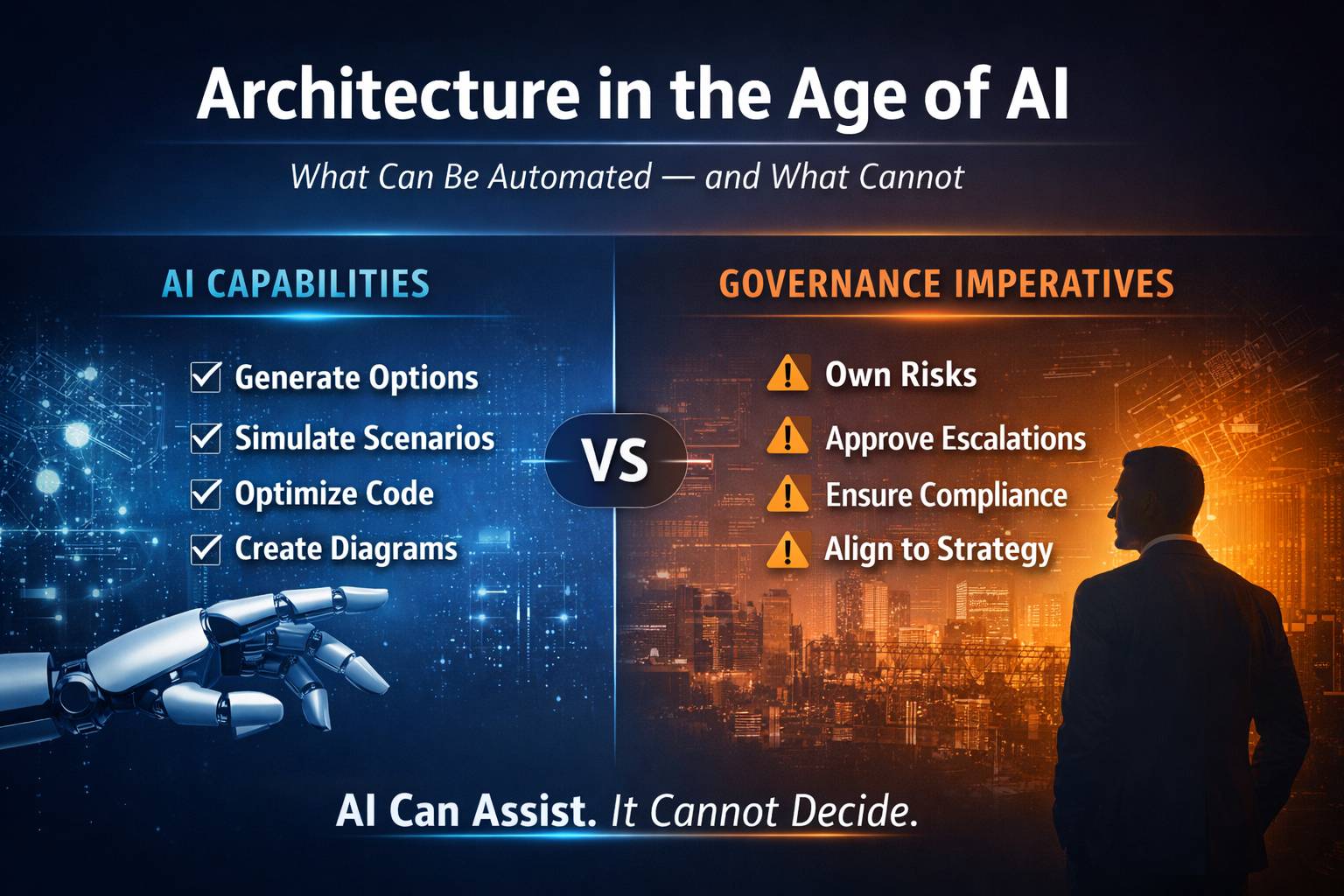
What AI Can Absolutely Do
AI is already capable of:
- Generating reference architectures
- Comparing cloud deployment models
- Suggesting integration patterns
- Identifying scalability bottlenecks
- Producing documentation
- Simulating trade-offs
These are powerful accelerators.
They reduce mechanical effort.
They increase option visibility.
They compress design cycles.
But none of these functions require authority.
They require analysis.
Architecture requires more than analysis.
The Mechanical Layer vs The Accountability Layer
Software architecture has two distinct layers:
- Pattern selection
- Component modeling
- Technology comparison
- Risk enumeration
- Performance estimation
AI excels here.
This layer is optimizable.
2. Accountability & Governance Layer
- Who approves platform shifts?
- Who accepts resilience trade-offs?
- Who escalates cross-domain conflicts?
- Who absorbs regulatory exposure?
- Who is accountable if the structure fails?
AI cannot hold accountability.
It cannot carry liability.
It cannot defend decisions before a board.
It cannot manage political capital.
Architecture lives here.
Architecture Is Decision Engineering
This argument does not stand alone.
It extends three structural principles already established:
- Enterprise defines environmental constraints.
- Decision rights must align with risk altitude (ADR-M)
- Architectural leadership shifts across lifecycle stages.
These are governance structures.
AI can support them.
It cannot replace them.
Because architecture is not design.
It is structured authority.
The Real Constraint: Consequence Ownership
Every architectural decision creates exposure:
- Financial exposure
- Security exposure
- Reputational exposure
- Operational exposure
- Regulatory exposure
Someone must own that exposure.
That ownership cannot be delegated to a model.
AI can recommend.
It cannot be accountable.
This is the boundary.
Where AI Strengthens Architecture
Instead of resisting AI, leaders should integrate it at the correct altitude.
AI should support:
- Option generation at solution level
- Risk analysis at technical level
- Pattern comparison during discovery
- Decision documentation for ADR records
- Impact simulation before modernization
AI becomes a structural assistant.
Not a decision authority.
The Danger of Misplaced Delegation
If organizations confuse generation with governance:
- Technical layers may redefine enterprise posture.
- Solution teams may bypass altitude constraints.
- Decision ownership becomes ambiguous.
- Audit trails weaken.
- Escalation boundaries blur.
This is not an AI failure.
It is a governance failure.
Automation magnifies misalignment.
The Governance Principle in the AI Era
Architecture fails when:
Tools are mistaken for authority.
Architecture stabilizes when:
Authority remains clearly assigned — even if tools become intelligent.
AI accelerates architecture mechanics.
Governance protects architecture integrity.
Implementation Guide (30 Days)
Phase 1: Clarify Decision Ownership (Weeks 1–2)
- Reconfirm ADR-M accountability assignments
- Document which decisions AI may assist
- Explicitly state which decisions remain human-accountable
- Align architecture boards on escalation boundaries
Deliverable: AI-Augmented Decision Responsibility Map
Phase 2: Controlled Integration (Weeks 3–4)
- Integrate AI into design exploration workflows
- Use AI for scenario simulation and documentation
- Preserve formal approval checkpoints
- Maintain human accountability signatures on all strategic decisions
Deliverable: AI-Assisted Architecture Playbook
Evidence from Practice
Organizations that adopt AI without governance discipline experience:
- Faster diagram production
- Increased architectural churn
- Confusion over final authority
- Decision reversals under pressure
Organizations that embed AI within decision rights frameworks experience:
- Faster option evaluation
- Stronger documentation discipline
- Reduced review fatigue
- Stable authority boundaries
Speed without accountability creates instability.
Acceleration must remain bounded by governance.
Action Plan
This Week:
Ask three questions:
- Which architectural decisions in your organization are advisory?
- Which are accountable?
- Can AI currently influence both?
If advisory and accountable are blurred,
governance risk exists.
Final Thought
AI will transform architecture.
But it will not replace it.
Because architecture is not pattern selection.
It is consequence ownership aligned to risk altitude.
Enterprise Architects define environment.
Solution Architects structure systems.
Technical Architects ensure execution integrity.
AI can assist all three.
It cannot become any of them.
Architecture succeeds not because it designs systems.
It succeeds because it assigns authority.
Next Step
If your organization is integrating AI into architectural workflows and wants to preserve governance integrity:
→ Book a 30-minute strategy consultation
Automation increases speed.
Only governance protects stability.