Executive Summary
- Who this is for: CTOs, Enterprise Architects, Engineering Leaders designing new systems
- Problem it solves: Organizations adopting complex architectures before they actually need them
- Key outcome: A simple architectural model that scales further than most teams expect
- Time to implement clarity: 30–60 days
- Business impact: Faster development, lower operational overhead, clearer system structure
The Architecture Complexity Trap
Modern architecture discussions quickly become complicated.
Teams start talking about:
- Microservices
- Event-driven systems
- Message brokers
- Workflow engines
- Distributed orchestration
Before the first real business problem is even solved.
The result is predictable.
Systems become complex before they become valuable.
But most organizations do not actually need complex distributed systems.
They need clear structure.
To understand this, imagine your software system as a house.
The House Analogy
A house contains multiple rooms.
Examples:
- Kitchen
- Living room
- Bedroom
- Bathroom
Each room has a purpose.
But rooms are not connected randomly.
People move through hallways.
And when someone arrives, they ring the doorbell.
This simple structure provides a useful way to understand minimum software architecture.
The Minimum Architecture Model
Most systems can operate effectively with three simple structural elements:
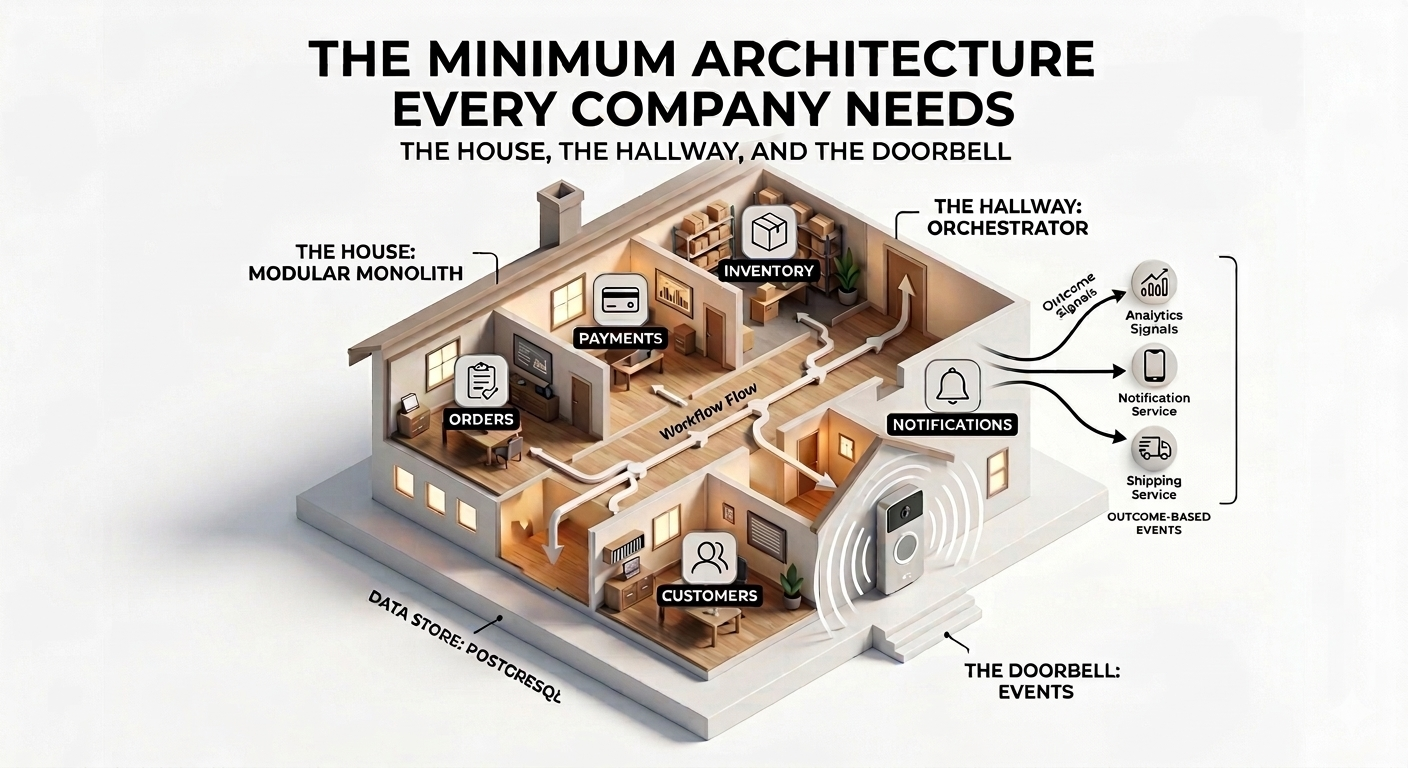
- The House → Modular Monolith
- The Hallway → Orchestrator
- The Doorbell → Events
This model keeps architecture understandable while still supporting growth.
1. The House: Modular Monolith
The house itself represents the core application.
In architectural terms this is a Modular Monolith.
Inside the system exist clearly separated modules.
Examples:
- Orders
- Payments
- Inventory
- Customers
- Notifications
Each module is like a room in the house.
Important characteristics:
- Clear module boundaries
- Shared runtime environment
- Internal communication through direct calls
- Consistent data model
This structure reduces:
- network latency
- operational complexity
- deployment coordination
Most systems can scale much further than expected with this model.
The problem is rarely the monolith.
The problem is lack of modularity inside it.
2. The hallways: Orchestrator
Inside a house, rooms do not connect randomly.
Movement happens through hallways.
In software architecture, this role is played by the orchestrator.
The orchestrator manages workflows across modules.
Example: Order Processing
- User places an order
- Inventory is reserved
- Payment is processed
- Order status is updated
- Notification is sent
Instead of modules calling each other directly, the orchestrator controls the process.
Structure:
User → Orchestrator → Modules
Benefits include:
- clear workflow visibility
- reduced module coupling
- easier debugging
- predictable execution flow
The orchestrator becomes the hallway connecting rooms.
3. The Doorbell: Events
Events are powerful.
But they are often overused.
Not every system interaction should produce an event.
In the house analogy, events behave like doorbells.
They ring when something important happens.
Examples of good events:
- OrderCompleted
- PaymentFailed
- AccountCreated
- ShipmentDispatched
These represent business milestones.
Other systems can react to them.
Example:
OrderCompleted → Notification System
OrderCompleted → Analytics Platform
OrderCompleted → Shipping Service
Events should signal important outcomes, not internal workflow steps.
The Clean Architecture Pattern
Combining these ideas creates a simple architecture structure.
User
↓
Orchestrator
↓
Modules (Modular Monolith)
↓
Business Events
Three layers emerge:
Core System
- Modular Monolith
Process Layer
- Orchestrator
Signal Layer
- Events
This architecture remains simple while supporting growth.
Why This Model Works
This architecture controls complexity in three important ways.
1. Structural Clarity
Modules create clear system boundaries.
Dependencies remain controlled.
2. Workflow Visibility
The orchestrator makes business processes explicit.
System behavior becomes easier to understand and debug.
3. Event Discipline
Events represent meaningful outcomes.
This prevents event overload and architectural confusion.
When Architecture Should Evolve
Over time, systems grow.
Architecture may evolve when:
- teams require independent deployments
- infrastructure scaling requirements differ
- system boundaries align with organizational teams
- runtime isolation becomes necessary
At that stage, parts of the monolith may evolve into services.
But this transition should happen when complexity demands it, not when architecture trends suggest it.
Implementation Guide (30–60 Days)
Introducing this architecture requires clarity more than technology.
Phase 1: Define Module Boundaries (Weeks 1–2)
Identify core business modules.
Examples:
- Orders
- Payments
- Inventory
- Customers
Success Metric:
Each module has clear ownership and responsibility.
Phase 2: Introduce Workflow Orchestration (Weeks 3–4)
Centralize process flows.
Avoid uncontrolled module-to-module calls.
Success Metric:
Business workflows are visible and traceable.
Phase 3: Establish Event Discipline (Weeks 5–8)
Define when events are allowed.
Events should represent business outcomes.
Success Metric:
Events represent meaningful system signals.
Evidence from Practice
Organizations that begin with:
- microservices
- complex event pipelines
- distributed orchestration
often struggle with:
- debugging complexity
- operational overhead
- deployment coordination
- developer onboarding
Organizations that begin with:
- modular monolith
- orchestration layer
- outcome-driven events
experience:
- faster delivery
- simpler systems
- clearer architecture evolution
Simplicity scales longer than expected.
Action Plan
This Week
Ask three questions:
- Do our systems have clear module boundaries?
- Are workflows controlled or scattered across services?
- Are events meaningful business signals or internal noise?
If these answers are unclear, architectural complexity may already be growing unnecessarily.
Next 30 Days
Introduce the minimum architecture model:
- Modular monolith
- Workflow orchestrator
- Outcome-based events
3–6 Months
Evaluate system growth and scaling needs.
Only introduce distributed services when organizational complexity requires it.
Architecture should evolve with the system.
Not anticipate it prematurely.
Final Thought
Most software architectures fail not because they are too simple.
They fail because they become complex too early.
A house works because:
- rooms have clear purposes
- hallways control movement
- doorbells signal important events
Software systems should follow the same principle.
Start with the house.
Use hallways to coordinate movement.
Ring the doorbell only when something important happens.
Simple architectures scale further than most teams expect.
Design Architecture That Matches Your System's Real Complexity
If your organization is debating microservices too early…
if event streams are multiplying without clear purpose…
or if workflows are scattered across services —
architecture may be growing faster than the business requires.
In a focused 30-minute Architecture Structure Diagnostic, we will:
- Evaluate whether your system boundaries are clear
- Identify unnecessary architectural complexity
- Define the minimum architecture required for your organization
- Establish a growth path that evolves architecture only when needed
No premature microservices.
No unnecessary orchestration layers.
No event chaos.
Just architecture that grows with your system.
→ Book an Architecture Strategy Session
or
The best architectures are often the simplest ones.