Executive Summary
- Who this is for: CIOs, CTOs, Enterprise Architects, AI Transformation Leaders
- Problem it solves: Confusion around LLM, RAG, Agents, and MCP leading to unstable AI initiatives
- Key outcomes: Clear architectural layering, reduced AI sprawl, improved governance control
- Time to implement: 60-90 days for structured AI capability alignment
- Business impact: Lower experimentation waste, controlled cost growth, safer AI scaling
The Enterprise AI Confusion Problem
Most organizations say:
"We need an LLM."
"Let's build an AI Agent."
"Add RAG."
"Use MCP."
Pilots begin.
Budgets are allocated.
Six months later:
- AI answers are inconsistent
- Costs fluctuate
- Security reviews slow progress
- Leadership questions ROI
The problem is not intelligence.
The problem is architectural clarity.
The Brain Model of Enterprise AI
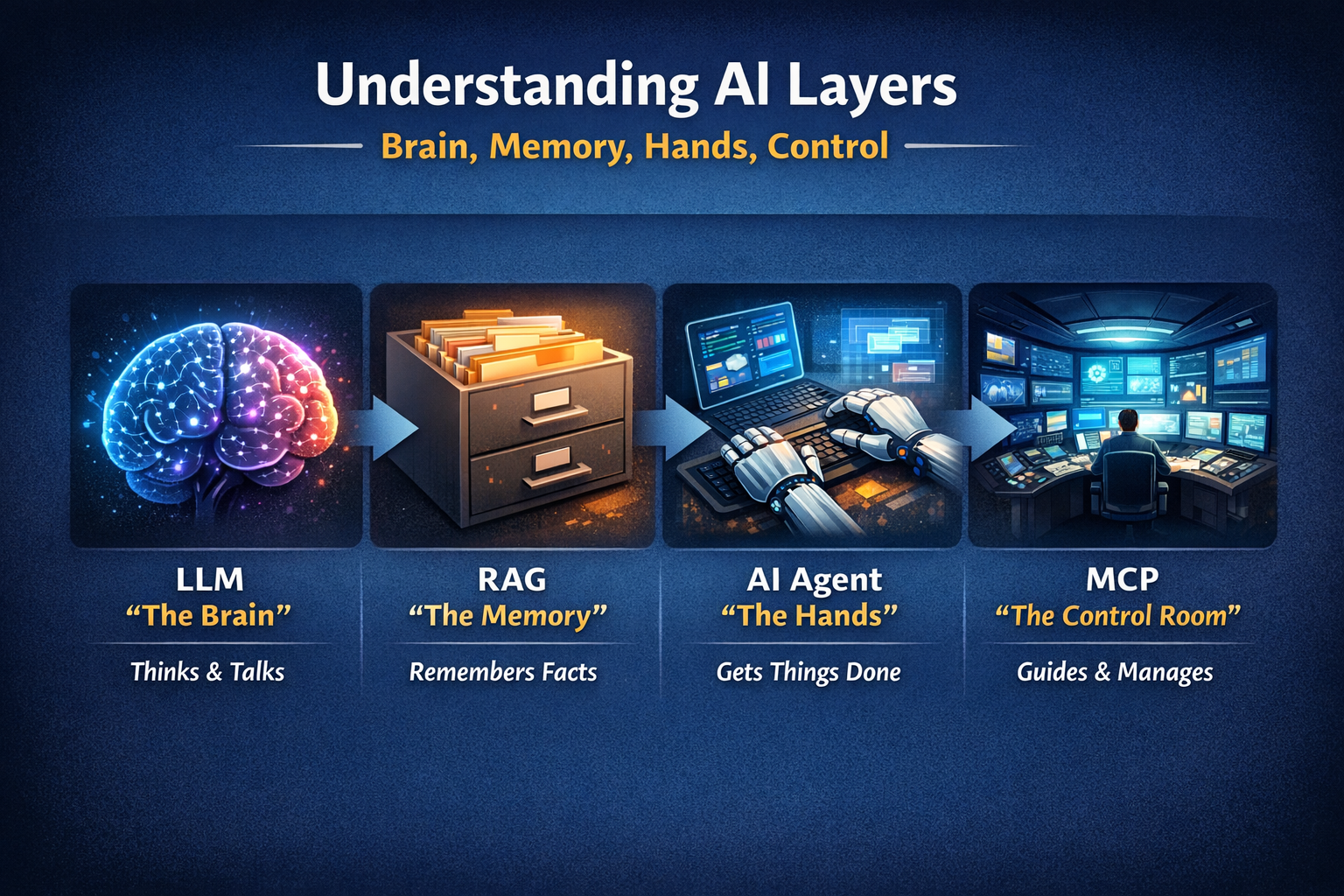
Every modern AI system can be understood using one simple metaphor:
Brain. Memory. Hands. Control.
If you understand these four, you understand modern AI architecture.
1. LLM = The Brain
An LLM is a brain.
It can:
- Think
- Write
- Explain
- Summarize
- Reason
It cannot:
- Access your private company data (by default)
- Press buttons
- Update systems
- Send emails
It only thinks.
Strategic insight:
LLM capability alone introduces minimal operational risk but limited enterprise value without context.
2. RAG = The Memory
Now give the brain memory.
RAG allows the model to:
- Look up internal documents
- Reference policies
- Retrieve knowledge base articles
- Use enterprise data before answering
Without memory → The brain guesses.
With memory → The brain checks first.
RAG does not make the brain smarter.
It makes it grounded.
Strategic insight:
RAG reduces hallucination risk but introduces data governance responsibility.
3. AI Agent = The Hands
Now give the brain hands.
An Agent can:
- Call APIs
- Send emails
- Update CRM records
- Trigger workflows
- Approve requests
Now the brain does not just think.
It acts.
This is where risk increases.
Advice is safe.
Action has consequences.
Strategic insight:
Agent deployment requires operational maturity and governance discipline.
4. MCP = The Control System
If the brain has hands, it needs control.
MCP (Model Context Protocol) standardizes how the brain talks to tools.
It defines:
- How tools are described
- How context is passed
- How capabilities are exposed
- How communication is structured
MCP is not intelligence.
It is not business rules.
It is structured communication that enables governance.
Strategic insight:
Without a control layer, agents become fragmented and difficult to audit.
The Enterprise AI Layering Framework
Modern AI systems should be classified into four layers:
- Reasoning (Brain)
- Knowledge (Memory)
- Action (Hands)
- Control (MCP)
Confusing these layers leads to instability.
Scaling without control increases risk.
Implementation Guide (90 Days)
Phase 1: Inventory (Weeks 1--3)
Objective: Map your AI footprint
Activities:
- List all LLM usage
- Identify RAG pipelines
- Audit agent tool access
- Classify autonomy levels
Success Metric: Complete AI capability map
Phase 2: Boundary Definition (Weeks 4--6)
Objective: Separate thinking from doing
Activities:
- Restrict agent permissions
- Standardize retrieval pipelines
- Introduce tool exposure standards
- Define approval checkpoints
Success Metric: No autonomous agent without defined boundary
Phase 3: Governance Integration (Weeks 7--12)
Objective: Institutionalize AI architecture discipline
Activities:
- Introduce AI architecture review board
- Log tool usage
- Track cost per workflow
- Align AI with enterprise architecture governance
Success Metric: AI governed like any core platform
Resource Estimate:
- Enterprise Architect
- AI Engineer
- Security & Compliance representation
Evidence from Practice
The Challenge
In a prior enterprise environment, multiple teams launched AI initiatives independently.
Some used only LLMs.
Some added retrieval.
Some deployed autonomous agents.
There was no unified architectural classification.
Cost grew unpredictably.
Security escalated concerns.
Executives hesitated to scale.
The Approach
We simplified everything into four categories:
Brain.
Memory.
Hands.
Control.
Agent autonomy was reduced until governance was structured.
Tool exposure was standardized.
Architectural review was formalized.
The Results
Within months:
- AI cost variance reduced
- Compliance approvals accelerated
- Operational stability improved
- Executive confidence increased
Clarity restored control.
Action Plan
This Week
List every AI initiative.
Label each as:
- Brain only
- Brain + Memory
- Brain + Memory + Hands
If control is unclear, you have architectural risk.
Next 30 Days
Run a structured AI layering workshop.
Define governance boundaries for agent capabilities.
3-6 Months
Integrate AI layering into enterprise architecture governance.
Conduct quarterly AI structural audits.
Align AI roadmap with operational maturity.
Final Thought
LLM thinks.
RAG remembers.
Agent acts.
MCP structures.
Enterprise AI instability does not come from intelligence limits.
It comes from architectural ambiguity.
Scale intelligence only after you structure it.
Next Step
If your organization is scaling AI without clear architectural layering
→ Book a 30-minute strategy consultation
AI transformation succeeds when intelligence is governed by structure.