Executive Summary
- Who this is for: CIOs, CTOs, Enterprise Architects, AI Strategy Leaders
- Problem it solves: Confusion between Generative AI, AI Agents, and Agentic AI leading to misplaced expectations and unmanaged risk
- Key outcome: Clear understanding of autonomy levels in enterprise AI
- Time to implement clarity: 30–60 days with structured review
- Business impact: Reduced risk, realistic adoption roadmap, controlled AI scaling
The Enterprise AI Confusion
Today, organizations say:
“We need Generative AI.”
“Let’s build an AI Agent.”
“Can we deploy Agentic AI?”
These terms are often used interchangeably.
They are not the same.
The difference is not intelligence.
The difference is authority and autonomy.
To understand this clearly, imagine your company as an office.
The Corporate Office Analogy
Think of AI systems as employees inside your organization.
Some write.
Some execute.
Some manage.
The difference is responsibility.
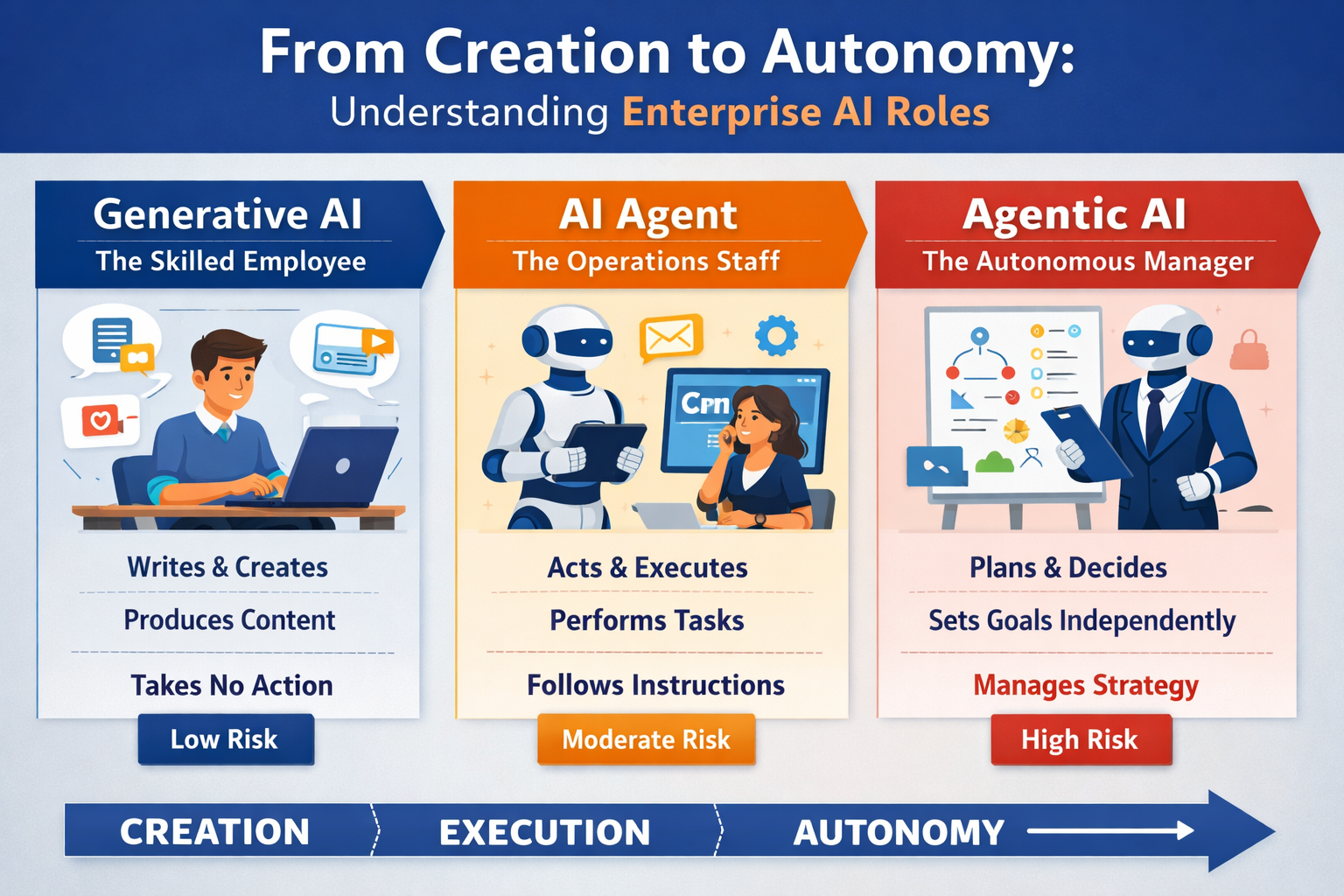
1. Generative AI = The Skilled Employee
Generative AI is like a talented employee who can:
- Draft reports
- Write emails
- Create presentations
- Produce designs
- Generate code
It creates.
It does not act on its own.
If you ask:
“Draft a client proposal.”
It drafts.
But it does not send the proposal.
It does not negotiate.
It does not update the CRM.
It waits for instruction.
Risk Level: Low
Governance Need: Content review and data control
Generative AI produces output.
It does not execute decisions.
2. AI Agent = The Operations Staff Member
Now imagine giving that employee system access.
The employee can now:
- Send the proposal
- Update the CRM
- Schedule meetings
- Trigger workflows
- Submit approvals
This is an AI Agent.
It does not just create.
It acts.
The difference is operational authority.
If misconfigured:
- Wrong emails get sent
- Records get overwritten
- Workflows trigger incorrectly
Advice is safe.
Action has consequences.
Risk Level: Moderate to High
Governance Need: Tool boundaries, approval checkpoints, logging
An AI Agent operates within defined permissions.
It still follows instructions.
3. Agentic AI = The Autonomous Manager
Now imagine promoting that employee.
Instead of telling them what to do, you give them a goal:
“Improve customer retention by 10%.”
They now:
- Analyze customer data
- Identify churn patterns
- Design outreach campaigns
- Send communications
- Monitor results
- Adjust strategy
They plan.
They decide.
They execute.
This is Agentic AI.
It is goal-driven.
It determines steps independently.
The system moves from task execution to delegated decision-making.
Risk Level: High
Governance Need: Strategic boundaries, audit trails, cost monitoring, autonomy limits
Agentic AI introduces:
- Multi-step reasoning
- Tool selection decisions
- Iterative improvement loops
- Reduced human oversight
This is not automation.
This is delegated authority.
The Autonomy Spectrum
Enterprise AI maturity can be viewed as three stages:
- Creation (Generative AI)
- Execution (AI Agents)
- Delegated Decision Authority (Agentic AI)
Many organizations attempt Stage 3 without mastering Stage 1 and 2.
That creates instability.
Why Most Enterprises Should Pause at Stage 2
Agentic AI requires:
- Clean, reliable data
- Standardized tool interfaces
- Clear escalation pathways
- Cost visibility per workflow
- Defined autonomy boundaries
- Strong architectural governance
Without these, autonomy becomes operational risk.
Intelligence scales faster than control.
That imbalance is dangerous.
Implementation Framework (60 Days)
- List all AI use cases
- Categorize each as:
- Generative
- Agent
- Agentic
- Identify current autonomy level
Success Metric:
Complete AI autonomy inventory.
Phase 2: Permission Review (Weeks 3–5)
- Audit tool access
- Introduce approval layers for action-based AI
- Define escalation triggers
- Limit high-risk actions
Success Metric:
No AI system with undefined authority.
Phase 3: Governance Alignment (Weeks 6–8)
- Integrate AI into architecture review
- Introduce cost-per-workflow monitoring
- Establish autonomy approval matrix
- Formalize logging and audit controls
Success Metric:
AI treated as an enterprise capability, not an experiment.
Evidence from Practice
Organizations that treat all AI as “just chatbots” face:
- Unpredictable cost growth
- Compliance delays
- Security escalations
- Executive hesitation to scale
Those that classify autonomy clearly:
- Reduce operational surprises
- Gain faster compliance approvals
- Improve executive trust
- Scale responsibly
Clarity precedes confidence.
Action Plan
This Week
List every AI initiative in your organization.
Label each as:
- Creation
- Execution
- Autonomous
If you cannot define its authority level, you have structural risk.
Next 30 Days
Introduce an AI Autonomy Review Framework.
Define:
- What AI may generate
- What AI may execute
- What AI may decide
3–6 Months
Establish an AI Governance Operating Model:
- Autonomy classification
- Risk tiering
- Audit logging
- Executive oversight
Autonomy without governance is delegation without control.
Final Thought
Generative AI writes.
AI Agents execute.
Agentic AI decides.
The difference is not capability.
The difference is authority.
Scale autonomy only after you structure it.
Next Step
If your organization is exploring AI autonomy and needs structural clarity:
→ Book a 30-minute strategy consultation
AI transformation succeeds when authority is governed before it is delegated.