Executive Summary
- Who this is for: Founders, CEOs, Strategy Leaders, Enterprise Architects
- Problem it solves: Organizations confuse strategic statements with executable strategy
- Key outcome: A 4-layer framework to evaluate whether a strategy is coherent, differentiated, and executable
- Time to apply: 2–4 weeks for structured strategic review
- Business impact: Reduced strategic drift, improved capital allocation, stronger execution alignment
The Strategy Illusion
Most companies say they have a strategy.
They present slides that include:
- Vision statements
- Growth targets
- Market expansion plans
- Digital transformation initiatives
But when you ask:
- What are we uniquely choosing to do?
- What are we explicitly choosing NOT to do?
- What capability must outperform competitors?
- How does execution reinforce positioning?
Silence.
The problem is not ambition.
The problem is structural clarity.
Strategy is not intention.
Strategy is a system of coherent choices.
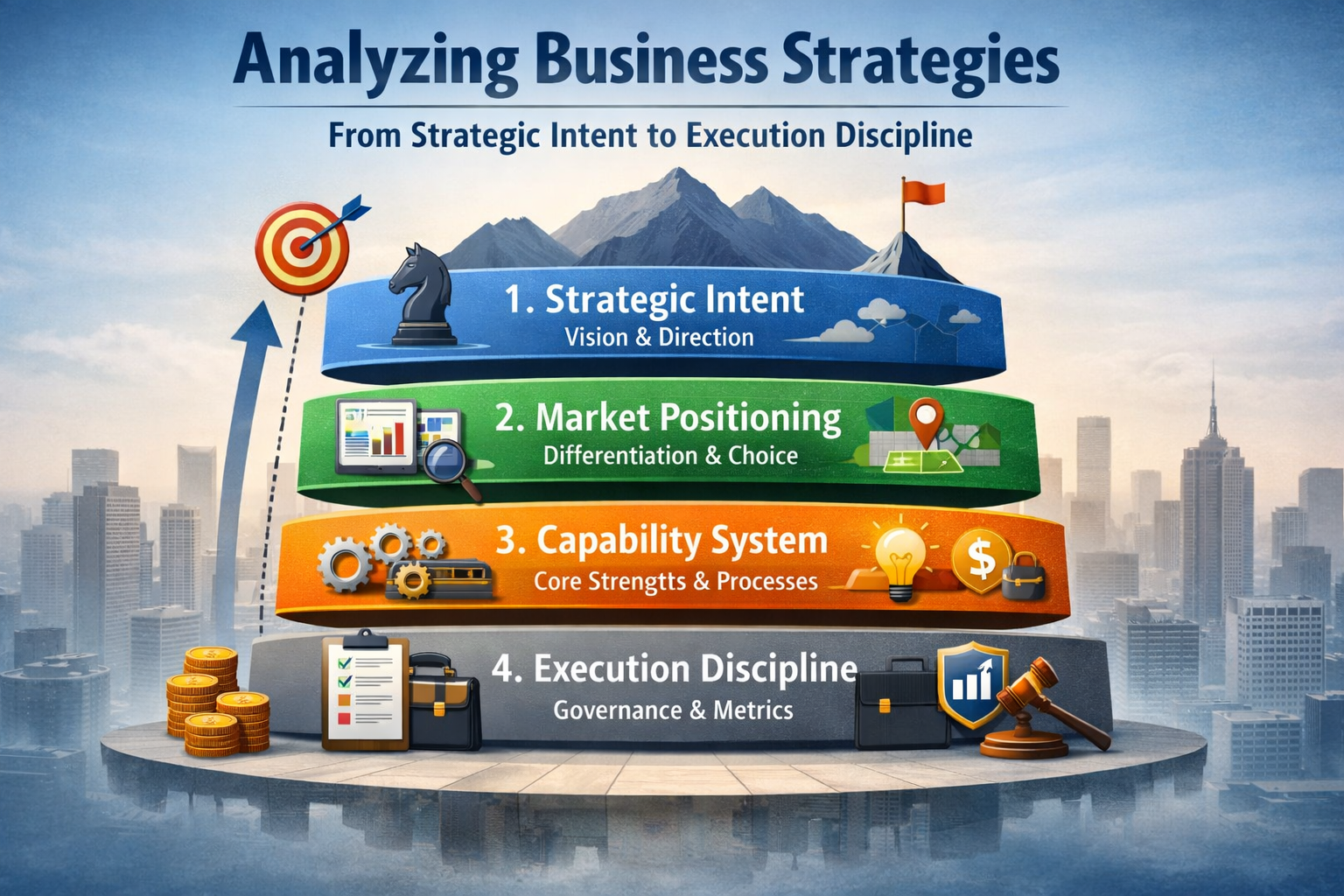
The 4-Layer Business Strategy Analysis Framework
Every business strategy can be evaluated across four structural layers:
- Strategic Intent
- Market Positioning
- Capability System
- Execution & Governance Discipline
If one layer is weak, the strategy eventually collapses.
This answers:
- Where are we choosing to play?
- What long-term outcome defines success?
- What economic logic drives this direction?
Strategic intent is not a slogan.
It must define:
- Target customer segment
- Value proposition focus
- Competitive arena
- Economic ambition
Warning Signs of Weak Intent
- “Be the best in the industry”
- “Expand globally”
- “Leverage digital”
- “Drive innovation”
These are aspirations.
Not strategic choices.
Strong intent defines direction and constraints.
2. Market Positioning: The Choice
Positioning answers:
Why should customers choose us over alternatives?
A real strategy makes trade-offs.
Examples:
- Premium differentiation vs cost leadership
- Focused niche vs mass market
- Platform ecosystem vs product excellence
If a company claims:
- High quality
- Lowest price
- Fastest delivery
- Most innovative
Simultaneously…
It likely has no positioning discipline.
Strategic Insight
If everything is priority, nothing is strategic.
Positioning requires saying no.
3. Capability System: The Engine
This is where most strategies fail.
A strategy is credible only if supported by a reinforcing capability system.
Capabilities include:
- Talent architecture
- Technology stack
- Supply chain design
- Data systems
- Operational processes
- Cultural behaviors
Ask:
What must we be structurally better at than competitors?
If your positioning is premium service,
but your operating model optimizes cost…
There is misalignment.
Strategy without capability coherence creates internal friction.
4. Execution & Governance Discipline: The Control Layer
Even a well-designed strategy fails without execution governance.
You must define:
- Decision rights
- Capital allocation rules
- Performance metrics
- Incentive alignment
- Risk management thresholds
Execution discipline determines whether strategy survives contact with reality.
Many organizations fail not because strategy is wrong,
but because governance contradicts it.
For example:
- Incentives reward short-term volume
- Strategy requires long-term differentiation
Misalignment destroys coherence.
The Strategy Coherence Test
To analyze any business strategy, ask five diagnostic questions:
- Is the intent clearly defined and economically grounded?
- Is the positioning differentiated and trade-off based?
- Are capabilities aligned to reinforce positioning?
- Does governance protect strategic priorities?
- Are resources allocated consistently with stated priorities?
If three or more answers are unclear,
the strategy is fragile.
Common Strategic Failure Patterns
1. Growth Without Positioning
Expansion into new markets without defining differentiation.
Result:
Revenue grows.
Margins compress.
2. Innovation Without Capability
Launching initiatives without operational readiness.
Result:
Pilot success.
Scaling failure.
3. Transformation Without Governance
Announcing transformation programs without adjusting incentives or capital allocation.
Result:
Strategy theater.
Operational continuity.
Implementation Guide (60 Days)
Phase 1: Strategic Clarity Audit (Weeks 1–2)
- Document explicit strategic choices
- Identify stated trade-offs
- Map economic logic
- Review competitor positioning
Deliverable: Strategic Intent & Positioning Brief
Phase 2: Capability Mapping (Weeks 3–5)
- Identify 5–7 critical capabilities required
- Evaluate current maturity
- Map capability gaps
- Align budget priorities
Deliverable: Capability Coherence Matrix
Phase 3: Governance Alignment (Weeks 6–8)
- Align incentives to positioning
- Adjust capital allocation criteria
- Redefine KPIs
- Introduce quarterly strategy coherence review
Deliverable: Strategy Governance Framework
Evidence from Practice
Organizations that treat strategy as messaging experience:
- Initiative overload
- Budget fragmentation
- Execution fatigue
- Leadership misalignment
Organizations that treat strategy as structural choice experience:
- Capital discipline
- Operational clarity
- Faster decision-making
- Stronger competitive identity
Clarity reduces friction.
Friction reduction improves performance.
Action Plan
This Week
Ask your leadership team:
- What are we deliberately not doing?
- What capability must outperform competitors?
- Where are we structurally weak?
If answers vary widely,
alignment is weak.
Next 30 Days
Run a Strategy Coherence Workshop:
- Clarify intent
- Define trade-offs
- Identify capability system
- Align KPIs
3–6 Months
Institutionalize:
- Quarterly strategy coherence review
- Capability maturity tracking
- Capital allocation discipline
- Incentive alignment with positioning
Strategy must be governed,
not just declared.
Final Thought
Strategy is not a vision statement.
It is a system of reinforcing choices.
Intent sets direction.
Positioning defines trade-offs.
Capabilities enable advantage.
Governance protects coherence.
Execution fails when structure is weak.
Analyze strategy as architecture.
Not aspiration.
Next Step
If your organization is re-evaluating its business strategy and needs structural clarity before scaling:
→ Book a 30-minute strategy consultation
Strategy succeeds when structure protects intent.