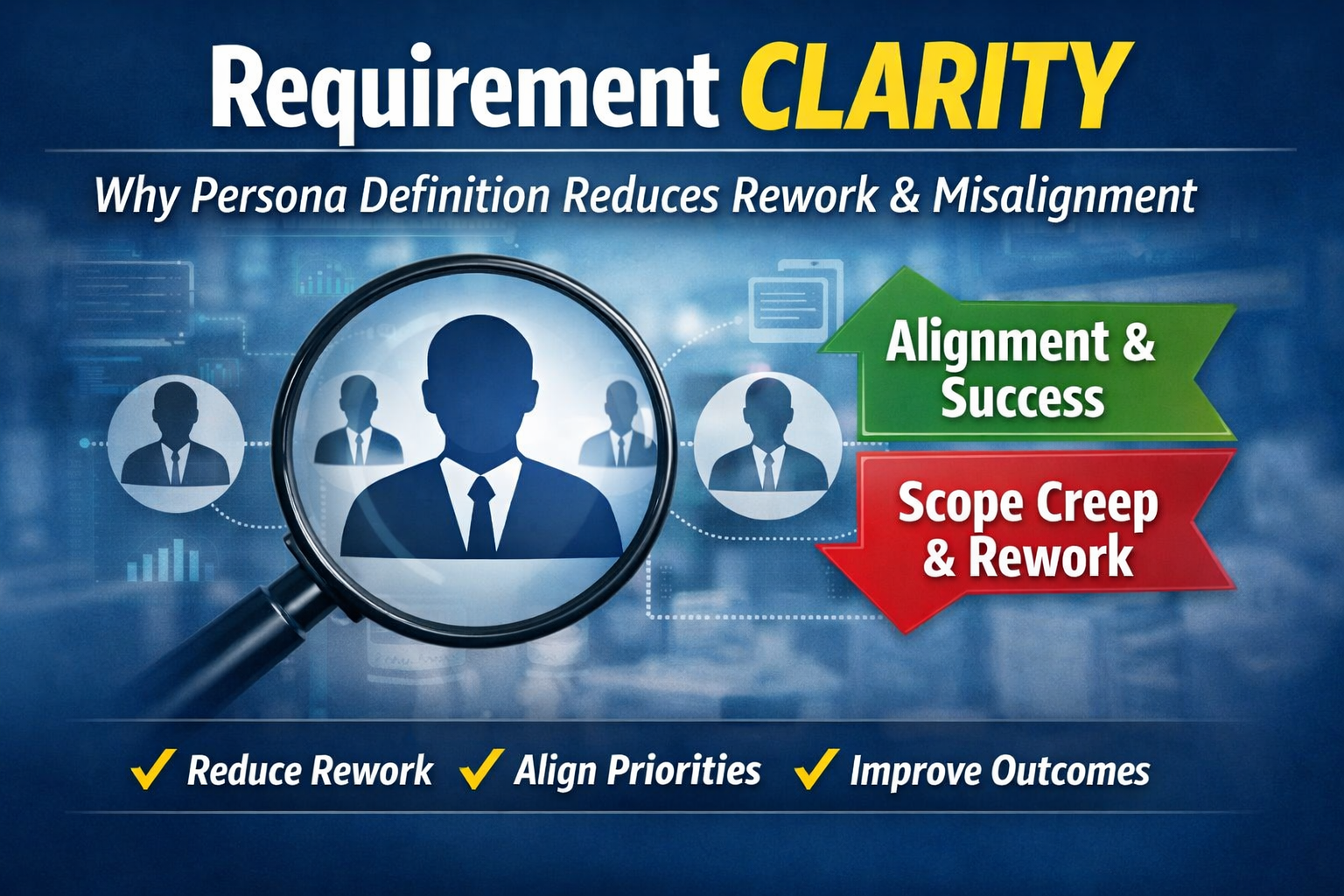
- Who this is for: CIOs, CTOs, Product Leaders, Engineering Heads
- Problem it solves: Ambiguous requirements leading to scope creep and rework
- Key outcomes: Clear ownership, measurable alignment, reduced decision friction
- Time to implement: 30–60 days for structured rollout
- Business impact: Reduced rework, faster approvals, improved delivery predictability
The Hidden Cost of Poorly Defined Personas
Your team delivered the feature on time.
Yet adoption is low.
Stakeholders question priorities. Scope shifts mid-sprint. Requirements get rewritten. Architecture decisions are challenged weeks after approval.
This is not a capability problem.
It is a persona clarity problem.
Research consistently shows that requirement errors are among the leading causes of project failure. Industry studies estimate that requirement defects can account for over 40% of rework costs in software initiatives. Rework at later stages can cost 10x–100x more than addressing issues early.
The gap is rarely technical.
It is a failure to define who the requirement truly serves, what outcome they expect, and how success is measured.
Structured persona definition closes that gap.
Why Traditional Persona Approaches Fail
Most organisations treat persona creation as:
- A UX exercise
- A marketing activity
- A one-time workshop
- A documentation artifact
As a result:
- Personas lack decision authority clarity
- Objectives are not measurable
- KPIs are missing
- Requirements are not traceable
In a previous engagement context, I observed a delivery program where features were consistently re-prioritised after development began. The root cause was unclear persona ownership. Multiple stakeholders believed they were the primary decision authority.
Without structured persona definition:
- Output increases
- Alignment decreases
- Governance weakens
This is not a documentation issue.
It is an execution discipline issue.
The Structured Persona Definition Framework
To make personas operational—not decorative—use a structured four-step model.
1. Classify Persona Type
Not all personas are the same. Identify which category applies:
- User Persona (system interaction)
- Decision Persona (approves direction)
- Buyer Persona (controls budget)
- Influencer Persona (shapes adoption)
- Operational Persona (impacted by process)
Every requirement must map to one primary persona.
If it cannot, clarity is missing.
2. Define Five Core Dimensions
Each persona must include:
- Primary Objective – What outcome are they trying to achieve?
- Pain Points – What frustrates the current state?
- Constraints – What limits their options?
- Authority Level – What decisions can they make?
- Success Metrics – How do they measure improvement?
Without measurable success metrics, personas remain vague.
3. Map Requirements to Persona Outcomes
Every requirement should answer:
- Which persona does this serve?
- Which objective does it improve?
- Which KPI does it impact?
- Who validates completion?
Example:
| Requirement | Primary Persona | Objective | KPI Impact |
|---|---|---|---|
| Automated approval flow | Operations Lead | Reduce cycle time | 20% faster processing |
| Executive dashboard | CIO | Improve visibility | Weekly KPI accuracy |
This prevents feature inflation and priority drift.
4. Align Persona with Governance
Integrate persona clarity into:
- Architecture decision records
- Backlog refinement
- Stage-gate reviews
- RACI models
Persona definition must influence approval pathways.
If governance ignores persona clarity, rework returns.
Implementation Guide (60-Day Rollout)
Phase 1: Assessment (Weeks 1–2)
Objective: Diagnose persona clarity gaps
Activities:
- Review current backlog
- Identify missing persona links
- Conduct 5–8 stakeholder interviews
Success Metric:
- 80% of active requirements mapped to primary persona
Phase 2: Structured Definition (Weeks 3–4)
Objective: Formalise persona model
Activities:
- Apply five-dimension framework
- Classify persona types
- Align KPIs with business objectives
Success Metric:
- Each persona has measurable success criteria
Phase 3: Governance Integration (Weeks 5–8)
Objective: Embed into delivery lifecycle
Activities:
- Update requirement templates
- Add persona validation checkpoint
- Train product and architecture teams
Success Metric:
- No requirement enters development without persona alignment
Evidence from Practice
The Challenge
In a previous role, I worked with a multi-team delivery program experiencing repeated scope adjustments and decision delays. Requirement volatility exceeded 30%, and rework cycles were increasing sprint overhead.
The Approach
We introduced structured persona classification and linked each backlog item to a primary decision persona and measurable KPI. Governance reviews required persona validation before approval.
The Results
Within three months:
- Rework reduced by approximately 35%
- Stakeholder approval cycles improved by 40%
- Requirement volatility decreased significantly
- Delivery predictability improved across streams
The key success factor was connecting persona clarity to governance discipline—not just documentation.
Action Plan
This Week
- Review your top 10 active requirements
- Identify the primary persona for each
- Check whether success metrics are measurable
Next 30 Days
- Introduce five-dimension persona template
- Add persona field to backlog items
- Validate decision authority for high-impact requirements
3–6 Months
- Integrate persona mapping into architecture review
- Align persona KPIs with OKRs
- Audit requirement volatility and rework trends
Final Thought
Requirements do not fail because teams lack technical skill.
They fail because intent, incentives, and authority are unclear.
Structured persona definition transforms requirements from assumptions into accountable outcomes.
If your organisation is experiencing scope instability, recurring rework, or stakeholder misalignment, persona clarity may be the missing foundation.
Next Step
If you are experiencing recurring requirement ambiguity, shifting priorities, or stakeholder misalignment, structured persona definition may be the missing foundation.
If you would like structured guidance on implementing this model within your delivery or governance framework:
→ Book a 30-minute strategy consultation
Clear personas drive predictable execution.