Executive Summary
- Who this is for: CIOs, CTOs, Enterprise Architects, Technology Leaders
- Problem it solves: Confusion between inspiration-driven leadership and control-driven governance
- Key outcome: Clear structural separation between direction-setting and constraint-enforcing mechanisms
- Time to implement clarity: 30–60 days
- Business impact: Reduced political friction, faster decision cycles, stronger execution stability
The Quiet Tension Inside Technology Organizations
Many organizations say:
“We need stronger technology leadership.”
What they often mean is:
“We need better governance.”
Or the reverse.
The two are not the same.
Technology Leadership drives direction.
Technology Governance protects stability.
When these are confused:
- Vision becomes bureaucracy
- Governance becomes personality-driven
- Innovation slows
- Accountability blurs
The result is structural instability — not capability shortage.
The Structural Difference
Technology systems require two forces:
- Direction (Where are we going?)
- Control (What boundaries must not be crossed?)
Leadership provides direction.
Governance provides constraint.
Both are essential.
They solve different problems.
1. Technology Leadership — The Directional Force
Technology Leadership is future-facing.
It answers:
- What capabilities must we build?
- Which technologies position us competitively?
- Where should we invest?
- What must we deliberately not pursue?
- How should architecture evolve over 3–5 years?
Leadership defines ambition.
It aligns technology with business strategy.
It creates movement.
- Vision articulation
- Strategic technology bets
- Capability roadmapping
- Talent shaping
- Investment prioritization
- Innovation sponsorship
Leadership tolerates ambiguity.
It operates under uncertainty.
It makes directional commitments.
Risk of Weak Technology Leadership
Without leadership:
- Technology becomes reactive
- Investments fragment
- Architecture drifts
- Teams optimize locally
- Strategic coherence weakens
Governance cannot compensate for missing direction.
It can only control what already exists.
2. Technology Governance — The Stability Mechanism
Technology Governance is boundary-facing.
It answers:
- Who is accountable for decisions?
- What standards are mandatory?
- What risks are unacceptable?
- How are exceptions managed?
- What is the approval pathway?
Governance defines constraint.
It creates structural safety.
It protects enterprise exposure.
Characteristics of Technology Governance
- Decision rights clarity
- Architecture review boards
- Standards enforcement
- Risk classification
- Compliance integration
- Auditability
Governance reduces variance.
It increases predictability.
It enforces discipline.
Risk of Weak Technology Governance
Without governance:
- Platform duplication increases
- Security exposure rises
- Technical debt accelerates
- Escalations multiply
- Authority becomes political
Leadership without governance becomes chaotic.
The Core Structural Distinction
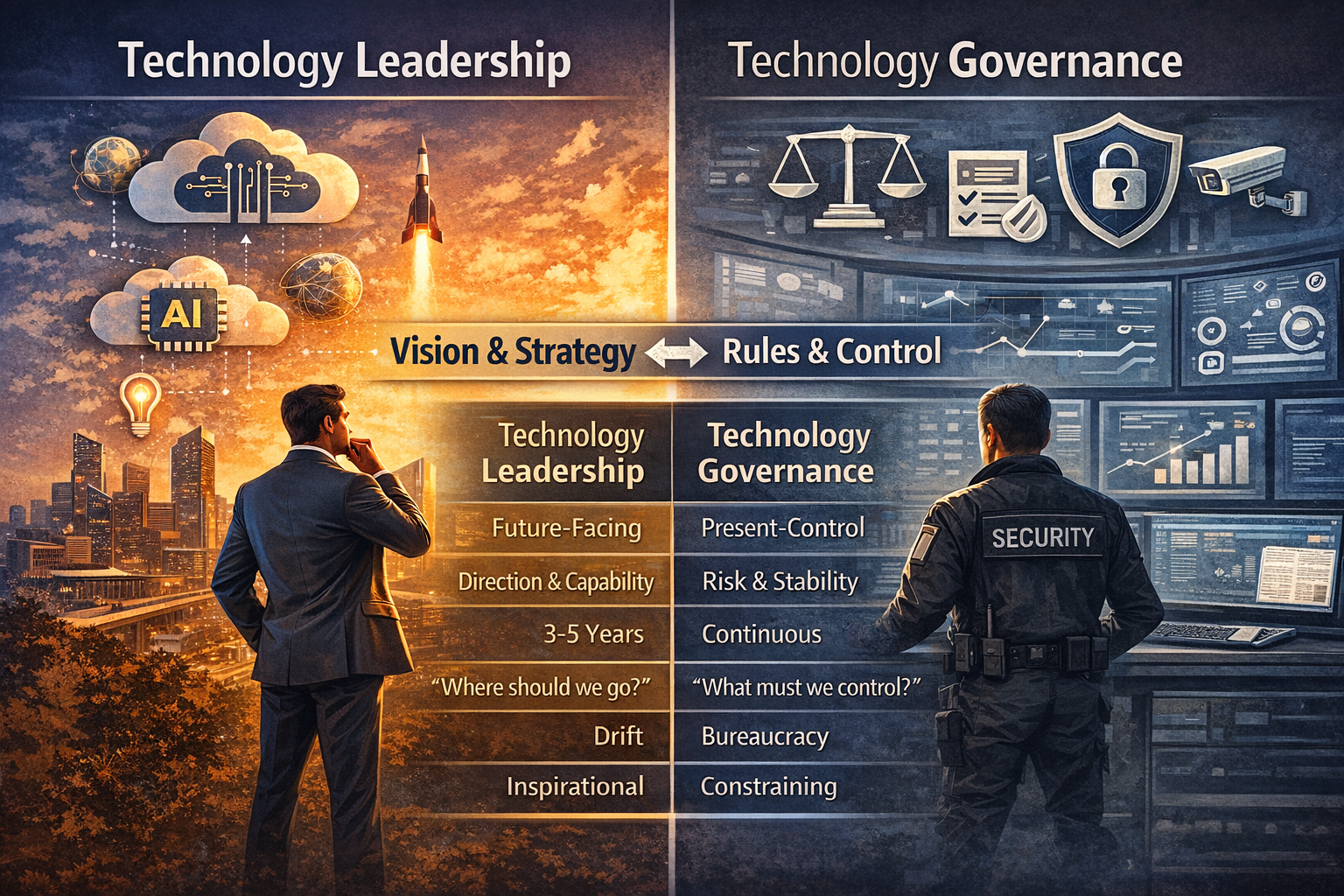
| Dimension | Technology Leadership | Technology Governance |
|---|---|---|
| Orientation | Future-facing | Present-control |
| Focus | Direction & Capability | Risk & Stability |
| Time Horizon | 3–5 years | Continuous |
| Primary Question | “Where should we go?” | “What must we control?” |
| Failure Mode | Drift | Bureaucracy |
| Energy Type | Inspirational | Constraining |
Leadership expands possibility.
Governance defines limits.
Expansion without limits creates chaos.
Limits without direction create stagnation.
Why Organizations Confuse the Two
Common patterns:
1. Governance Replaces Leadership
Architecture boards debate innovation instead of enforcing boundaries.
Standards become default strategy.
Risk avoidance replaces ambition.
Result: Stability without growth.
2. Leadership Overrides Governance
Senior leaders bypass review processes.
Exceptions become common practice.
Standards become optional.
Result: Vision without structural control.
3. Same Person, No Structural Separation
A CIO or CTO plays both roles without explicit distinction.
Decisions become personality-driven instead of system-driven.
Stability depends on individuals.
Not structure.
The Governance–Leadership Interaction Model
Technology Leadership defines:
- Target architecture posture
- Cloud and AI direction
- Platform consolidation strategy
- Build vs buy philosophy
Technology Governance ensures:
- Projects adhere to posture
- Exceptions are documented
- Risk is assessed
- Accountability is clear
Leadership sets climate.
Governance enforces building codes.
They must reinforce each other.
Not compete.
Implementation Guide (60 Days)
Phase 1: Role Separation (Weeks 1–3)
- Document strategic technology direction
- Identify formal governance mechanisms
- Separate vision forums from review forums
- Clarify decision rights
Success Metric: No meeting mixing strategy definition and compliance enforcement.
Phase 2: Structural Alignment (Weeks 4–6)
- Align governance checkpoints with strategic posture
- Define exception approval pathways
- Ensure leadership communicates strategic guardrails
- Introduce quarterly leadership–governance alignment review
Success Metric: Reduced decision reversals and escalation conflicts.
Evidence from Practice
Organizations that blur leadership and governance experience:
- Political architecture boards
- Strategy debates inside compliance meetings
- Overridden standards
- Slow innovation
Organizations that structurally separate them experience:
- Faster innovation within boundaries
- Clear accountability
- Stable platform evolution
- Reduced cross-role friction
Clarity reduces emotional escalation.
Structure increases trust.
Action Plan
This Week
Ask:
- Who defines technology direction?
- Who enforces technology boundaries?
- Are those mechanisms structurally distinct?
If unclear,
instability is already forming.
Next 30 Days
- Separate leadership forums from governance boards
- Define written strategic technology posture
- Clarify approval authority for standards and exceptions
3–6 Months
- Integrate governance metrics into executive reporting
- Conduct quarterly strategic posture reviews
- Audit exception frequency and root causes
Leadership must inspire movement.
Governance must protect integrity.
Both must be explicit.
Final Thought
Technology Leadership creates motion.
Technology Governance creates stability.
Motion without stability leads to collapse.
Stability without motion leads to irrelevance.
Mature technology organizations institutionalize both —
and make the boundary between them visible.
Clarify Direction Before Control Becomes Political
If governance meetings feel like strategy debates…
if strategic decisions bypass formal review…
or if standards change based on personalities —
you do not have a capability gap.
You have a structural separation gap.
In a focused 30-minute Technology Leadership & Governance Diagnostic, we will:
- Identify where direction and control are blurred
- Map decision rights clarity
- Evaluate exception patterns
- Define structural adjustments for stability and speed
→ Book a 30-minute strategy consultation
or
Technology maturity is not about stronger personalities.
It is about clearer structural boundaries.